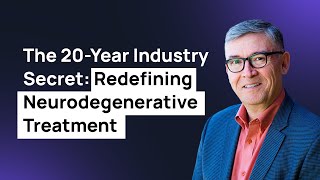
"Most disease is really related to lifestyle and environmental factors. If we can identify all of the factors that create this disruption and restore harmony — homeostasis — the disease largely goes away. Whether you're working with Alzheimer's, Parkinson's, MS — it's very doable."
Dr. Ken Sharlin trained at Emory and the University of Virginia. He has run clinical trials at the intersection of conventional neurology and functional medicine for over two decades. He has documented, in peer-reviewed research, patients who came to him with the neuropathological changes of Alzheimer's disease — and who no longer have those neuropathological changes.
He doesn't call it miraculous. He calls it logical.
This conversation covers a lot of ground: the gut-brain connection in Parkinson's, what's missing upstream in MS treatment, the emergence of biomarker platforms like Octave Bioscience's disease activity score, why consumer health technology is outpacing clinical neurology, and what sponsors most often get wrong when designing trials. Running underneath all of it is a coherent philosophy: neurological disease isn't primarily genetic. It's a disruption of homeostasis. And homeostasis can be restored.
Disease Reversal as a Clinical Reality
Dr. Sharlin's framework starts with a distinction between disease-centered medicine and root-cause medicine. Conventional neurology operates in the disease-centered mode: you have Alzheimer's, you get this drug. You have MS, you get this drug. The disease is treated as a fixed entity with a standardized response.
Functional medicine operates differently. Its philosophical foundation — shared across Ayurvedic and traditional Chinese medicine traditions — is that illness begins upstream from the diagnosis, in disrupted homeostasis across interconnected organ systems. The gut, the immune system, the endocrine system, the nervous system don't operate separately. When one shifts out of balance persistently, the others adapt. That maladaptive response is what we diagnose as disease.
The clinical implication: treating the diagnosis manages symptoms. Restoring homeostasis can reverse them.
This isn't theoretical for Dr. Sharlin. He has documented it. With precision diagnostics, behavioral change, personalized nutrition and movement protocols, and targeted interventions — conventional, regenerative, or energy-based — he has patients who presented with early Alzheimer's disease who no longer carry those markers. The gun loaded by genetics was loaded. Lifestyle and environment pulled the trigger. Change the environment, lower the inflammation, restore the balance — and the disease can go away.
The Gut–Brain Connection in Parkinson's
One of the strongest examples of systems biology in neurology is Parkinson's disease. The field has understood for years that alpha-synuclein — the pathological protein associated with PD — may not originate in the brain. It may begin in the digestive tract and travel via the vagus nerve into the brain.
This tracks directly with the functional medicine philosophy that has long held: heal the gut, and you go a long way toward healing the patient. What was passed down as clinical tradition without mechanistic support is now being validated by the science. The tradition and the research are intersecting.
For Dr. Sharlin, this means treating Parkinson's patients with attention to gut health, microbiome, inflammatory load, and vagal tone — alongside whatever conventional therapies are appropriate. Not instead of them. In addition to them.
What MS Treatment Still Gets Wrong
Multiple sclerosis has made the most therapeutic advances of any area in neurology. From betaseron in 1993 — distributed via lottery because supply was so limited — to 27 or 28 approved disease-modifying therapies today, the field has genuinely transformed outcomes for many patients.
But all of those mechanisms, Dr. Sharlin notes, focus on the inflammatory component of MS. BTK inhibitors, CD20 B-cell depletion therapies, T-cell sequestration drugs — water on the fire. What's missing is getting further upstream to the root causes of inflammation, and getting downstream into progressive non-inflammatory MS, where the neurodegenerative process continues even when inflammation is suppressed.
For prescribers, the challenge is stratification. With 27-plus options, how do you know which drug to prescribe to which patient? The current approach uses blunt proxies: efficacy tier, age, gender, lesion burden. These are relevant but don't characterize the individual's disease biology.
Biomarker-Driven Precision in MS
Octave Bioscience has developed a disease activity test for MS that tracks 18 biological markers across four domains: neuroinflammation and immune modulation, myelin biology, and neuroaxonal integrity. Patients score from 1 to 10. Those in the high disease activity category (7.5–10) are 23 times more likely to develop a new MRI lesion in the next 6 months compared to patients scoring 1–4. That's predictive power that enables proactive treatment decisions — not reactive ones.
Dr. Sharlin's vision: pair tools like this with individual disease biology profiles to match each patient to the therapy most predictively likely to achieve remission or reversal. Precision medicine applied at the level of individual mechanism, not demographic proxies.
The barrier, he argues, isn't scientific. It's adoption. The 2024 McDonald criteria for MS diagnosis still don't mention neurofilament light chain or glial fibrillary acidic protein — biomarkers with strong validation — because practicing neurologists aren't yet using them routinely. The average practicing physician is running about 10 years behind the most validated emerging technologies. That gap needs to close.
Energy-Based Therapies and the Consumer Health Gap
Some of the most interesting territory in this conversation is energy-based therapeutics: photobiomodulation, transcranial direct current stimulation (tDCS), transcranial magnetic stimulation (TMS), and sound-based neuromodulation. Each leverages principles of brain entrainment — applying specific frequencies of electromagnetic or sound energy to drive the brain toward targeted physiological states.
tDCS has been available for 25 years. There's substantial published data on applications for cognitive decline, mood enhancement, language recovery post-stroke, and motor rehabilitation. TMS is FDA-approved in psychiatry. And yet these tools are largely absent from standard neurology clinics.
Consumer health has moved faster. Apple Watch, continuous monitoring wearables, brain entrainment devices available without prescription — these are reaching patients outside the clinical system. Dr. Sharlin sees this as both a gap and an opportunity: the clinical adoption lag needs to close, and the tools that help patients outside the clinic should be incorporated into integrative care models rather than dismissed.
Lessons From Running Trials as a PI
Dr. Sharlin's perspective on clinical research is grounded and specific. He has tremendous respect for what sponsors do — the complexity of orchestrating a trial with CROs, vendors, IRBs, and regulatory timelines is extraordinary. But the friction he experiences repeatedly is timeline: sponsors approach his site about a trial, the trial doesn't start for another year, and patients he had identified as good candidates have moved on.
The opportunity AI creates, in his view, is timeline compression — both in preparation and in execution. Better site identification, faster protocol design, more efficient regulatory interaction, continuous remote monitoring so subjects travel to sites less often. And in MS specifically, an emerging challenge: his patients do so well on existing therapies that recruiting for new studies is increasingly difficult. The answer is exploring truly novel mechanisms — like an mRNA vaccine targeting Epstein-Barr virus that could prevent MS before symptoms even begin.
What You'll Learn
- Why most neurodegenerative diseases are driven by lifestyle and environmental factors — not just genetics
- How restoring biological homeostasis can lead to symptom improvement and genuine disease reversal
- The difference between diagnostic, prognostic, and predictive biomarkers — and why all three matter
- How precision medicine is changing treatment selection in multiple sclerosis and beyond
- Why behavioral change is foundational to functional and integrative neurology
- The role of emerging technologies: neuromodulation, photobiomodulation, sound, and electromagnetic therapies
- What sponsors most often underestimate when designing and launching clinical trials
- Why patient recruitment in MS is becoming harder despite — or because of — therapeutic advances
Episode Highlights
- [01:49] Intro: Balancing Clinical Practice With Running Clinical Trials
- [02:44] The Gut–Brain Connection And Root-Cause Medicine
- [09:27] The Rise Of Precision Medicine And Biomarker-Driven Care
- [12:17] Why Behavior Change Is The Hardest And Most Important
- [15:45] What's Missing In Modern MS Treatment Approaches
- [17:43] Predictive Biomarkers And Personalizing MS Care
- [20:52] Why Better Diagnostics And Prognostics Lag Behind Innovation
- [23:13] Energy-Based Therapies: Light, Sound, And Brain Stimulation
- [26:28] Why Consumer Health Is Ahead Of Clinical Neurology
- [29:09] Lessons From Running Clinical Trials As A Principal Investigator
- [32:12] Preventing MS Before Symptoms Begin
- [35:59] Closing Thoughts: Empowering Patients Through Partnership