In 2025, we went deep on neuropsychiatry and focused on building the systems and partnerships that drive consistent enrollment.
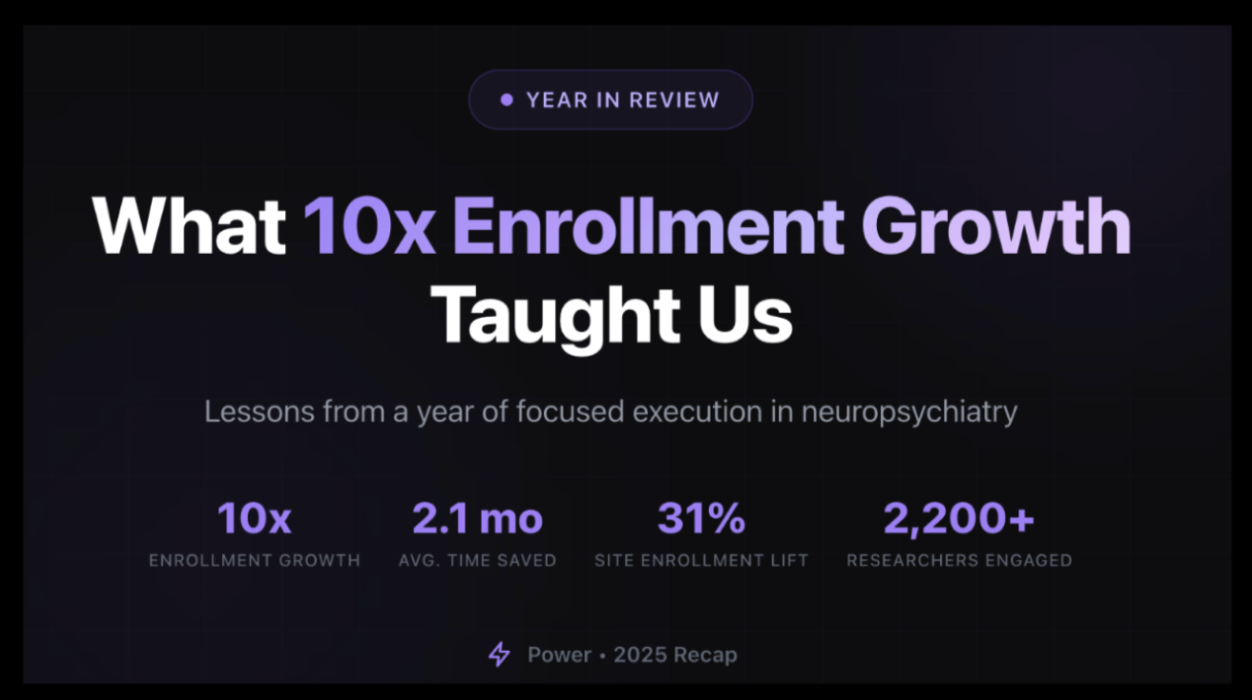
The results have exceeded our expectations. We've become the recruitment partner of choice for many of the leading neuropsychiatry programs, now working with several of the top 10 pharmaceutical companies heading into 2026. This year, over 2,200 researchers engaged with patients through our platform, and we achieved 10x growth in our core metric of patients enrolled. Across our core sponsor programs, we averaged 2.1 months of enrollment time saved and a 29% lift in total site enrollments.
The numbers tell part of the story. But the more interesting story is how we got there, and what we learned along the way that might be useful to you.
What Actually Moved the Needle
We spent much of 2025 working with clin ops leaders, gathering site and sponsor feedback, and testing core hypotheses to understand the levers that drive successful recruitment. We also worked closely with site leadership to hone their screening processes and optimize the recruitment journey for patients.
Here's what the data showed.
Patients want to call you (if you let them). Our patient-initiated call rate grew 225% this year, from around 14% in early 2025 to nearly 46% by November. These patient-initiated calls now account for 35% of all site visit bookings (SVBs) across our network.
The insight was clear: when patients feel informed and empowered through the application process, they take action. We redesigned our 'apply' flow around this principle, adding in-flow calling (so patients can connect with a clinic immediately after pre-qualifying), waterfall calling to route patients to the next available coordinator, a post-match checklist that shows patients exactly what steps remain, and much more.
Voice pre-screening changes conversion math. We rolled out our proprietary AI Call Center ("Clara"), and the results were notable: a 25% improvement in SVB rates compared to patients who didn't speak with our agents. AI driven voice conversations grew over 300% from July to November, reaching thousands of patients per month by year-end.
Call efficiency doubled. Our call-to-conversation rate improved 2x across the network this year. Each call is now twice as efficient at generating a meaningful patient conversation, driven by better timing (calling patients when they're most engaged), improved ranking algorithms, and reducing time-to-first-call after a patient signs up.
The Month 3 problem is real, and predictable. We wrote about this earlier this year (see: Breaking the Enrollment Plateau), and everything we saw in 2025 confirmed it: sites start strong, then hit a "wall" around month 3 when their readily-available patient pools are exhausted. The 60-day pipeline metric we introduced became our early warning system. When qualified patients in screening drops below 15, that's your signal.
What We Built
Our product team shipped constantly this year. A few things stand out.
PowerDialer became one of our stickiest products. We started 2025 without any phone screening capabilities in our software. By year-end, over a third of all phone screens take place through our platform, with the majority of our active site users adopting it as part of their workflow. The impact on booking efficiency has been substantial.
Real-time analytics that sites actually use. Based on feedback, we launched an analytics page in the Power portal where site leadership can monitor recruitment performance, see what they can do to boost conversion rates, and benchmark how their booking performance compares to other sites. Since its launch in mid-2025, usage has continued to rapidly expand, with hundreds of sites actively using it in recent weeks.
What We Learned (And Shared)
We made a commitment in 2025 to share what we're learning with the broader clin ops community.
This year, we sat down with some of the sharpest minds in drug development: CEOs and CMOs at leading biopharma companies, heads of clinical operations, principal investigators and others. What we heard shaped how we think about execution, and we've tried to share those insights each week.
Some of the frameworks that resonated most with readers:
- The ROI Reality Check: Three financial levers that quantify recruitment investments, showing how a 150-patient neuroscience trial can see $20M+ in value created through direct cost avoidance, site activation savings, and NPV timeline impact.
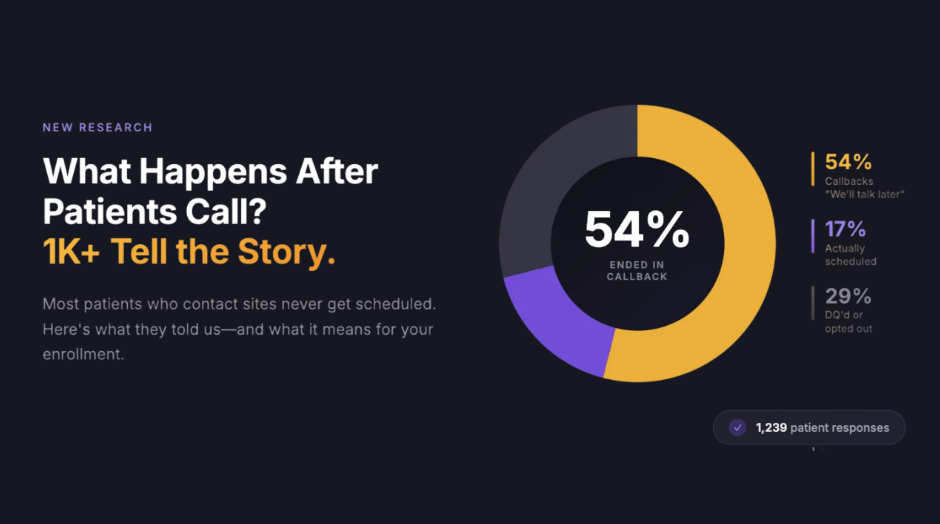
- The Silent Dropout: Our survey of 1,000+ patients revealed that 54% of patient-site contacts end in callback purgatory, with only 17% resulting in a scheduled visit.
- Why Every Trial Needs a Heat Map: How real-time site monitoring catches struggling sites weeks before monthly reports would, and the early warning signs that predict enrollment failures.
Our content reached well over 1 million impressions this year, with a growing audience of clinical operations leaders who value real-world insights over marketing fluff.
Looking Ahead
We're entering 2026 focused on becoming the most-loved patient recruitment company among sponsors and sites.
Neuropsychiatry remains our foundation. We've built deep expertise in CNS, strong relationships with the leading programs in the space, and operational infrastructure that works.
At the same time, we're seeing strong demand in additional therapeutic areas — including immunology, rheumatology, and dermatology — where we see similar opportunities to bring systematic recruitment approaches to underserved patient populations.
To our sponsors who trusted us with their programs, to the sites who embraced new workflows and tools, and to the patients who took a chance on research: thank you.
Here's to a strong 2026 💪
Want to discuss your 2026 recruitment strategy? Schedule a call with us here.